Portal, AZ - Rodeo, NM

Serving The Communities Of Portal and Rodeo  (www.portal-rodeo.com)

Chiricahua Regional Council

WHO WE ARE

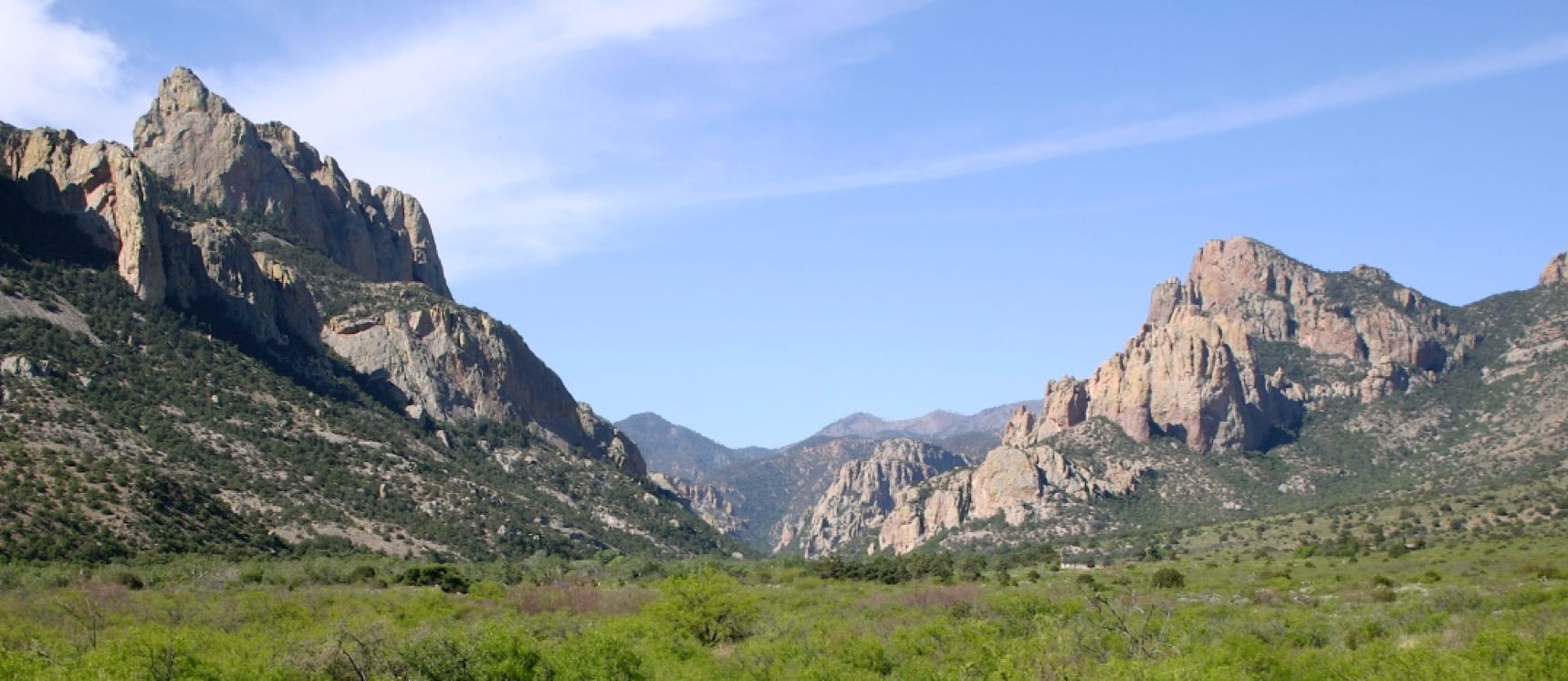
The Council is a citizens’ watchdog group that monitors public agency actions and other issues affecting the Chiricahua, Peloncillo and Dragoon Mountains and nearby areas of southeastern Arizona, southwestern New Mexico, and adjacent northern Mexico.

We protect valuable, intact habitats and champion the region’s natural and cultural integrity. Dark skies, open space, outstanding species diversity, corridors that link habitats, our ranching heritage––all of these values make our region what it is. Together, these treasures draw tens of thousands of visitors annually, all contributing to nature tourism, which underpins our regional economy.

The CRC promotes responsible land use and wise, science-informed stewardship of our unique natural heritage. Our broad constituency includes scientists, ranchers, birders, naturalists, astronomers, artists, residents, visitors, and many others, who value our region’s spectacular qualities.


A major strength of the organization lies in its broad constituency. Our membership includes biologists, ranchers, birders, residents, visitors, and other segments of the general public with a strong interest in the region’s well-being. 

_________________________________________


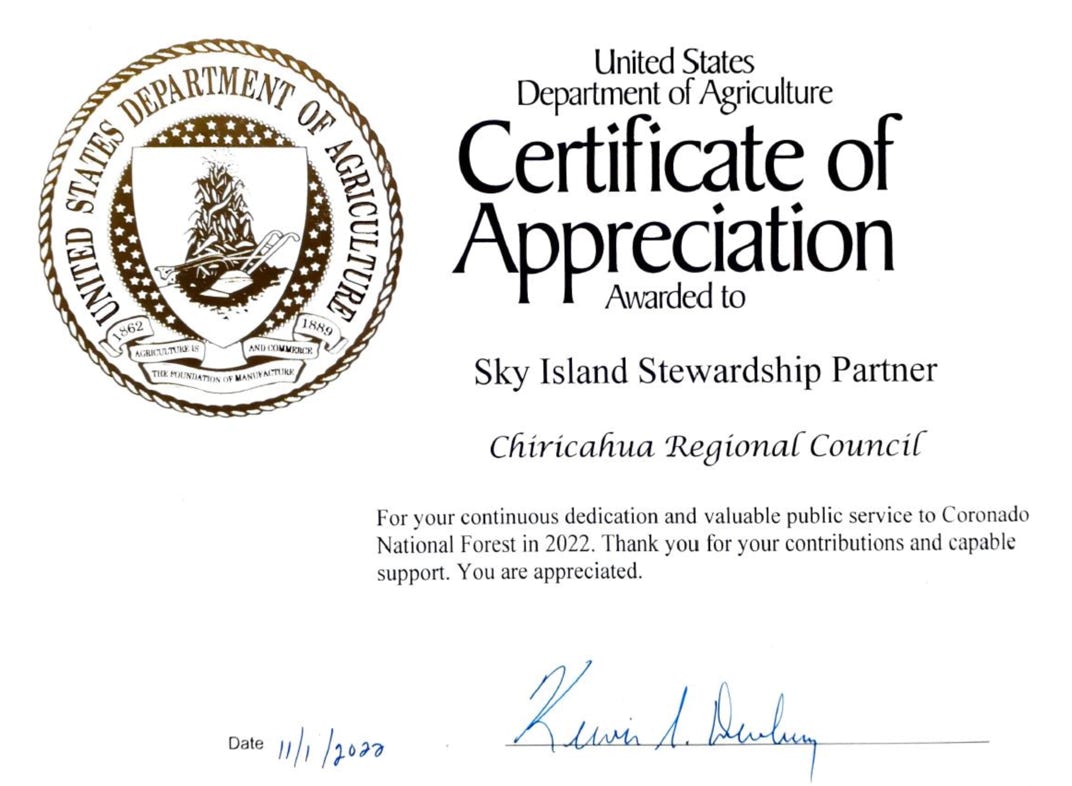
Our Stewardship Program has been one of our greatest successes. We value our collaborations in this area, including those with Wild Arizona, Friends of Cave Creek Canyon, and the US Forest Service. In 2022, we were honored to receive a certificate of appreciation for our work in the Chiricahuas.

Spring Newsletter

WHAT WE DO

Chiricahua Regional Council


The CRC works on issues affecting the Chiricahua and Peloncillo region and focuses on maintaining healthy, intact habitats. We disseminate information about potential threats to the region, as those threats arise. We advocate careful land stewardship and seek to educate the public, as needed, on any aspect of natural history, conservation and land use, including sound grazing practices. Diverse interests from the community––from biologists to ranchers––are represented on our Board of Directors.


BOARD OF DIRECTORS

President: Dirk Sigler

Vice President: Curt Bradley
Secretary: Elly van Gelderen

Treasurer: Eskild Petersen

Wynne Brown

Philip Hedrick

David Hodges

Noel Snyder

Helen Snyder


Advisory Council

Amy Amoroso

Josiah Austin

Jim Downer

Diana Hadley

Paul Hirt

Michelle Lanan

Gregg Magee

Narca Moore-Craig

Jonathan Patt

Kim Vacariu

Alice Wakefield

Richard Webster


MEMBERSHIP

A 2-year membership costs $20. When issues arise affecting the Chiricahua-Peloncillo-Dragoon region, we inform our membership of the problem and recommend actions to remedy the situation. These notices come at irregular (and, thankfully, infrequent) intervals––however, when action has been needed, our members have risen to the challenge, and have been very effective at protecting the local biological and cultural values.


CONTACT US

For information, email us at chiricahuaregionalcouncil@gmail.com.


Chiricahua Regional Council

PO Box 16480

Portal AZ 85632


CRC WEB SITE

Dear CRC Members,

Spring is arriving in the Chiricahuas, and with it comes a season of meaningful work across the mountains we love. As we look ahead to our April 11 Board of Directors and Advisory Council meeting, I want to share some of the exciting projects underway and issues that deserve your continued attention.

Stewardship: A Spring Full of Trail Work

This April and early May will be among our most active trail work seasons in recent memory, and we couldn’t be more proud of the partnerships making it possible.

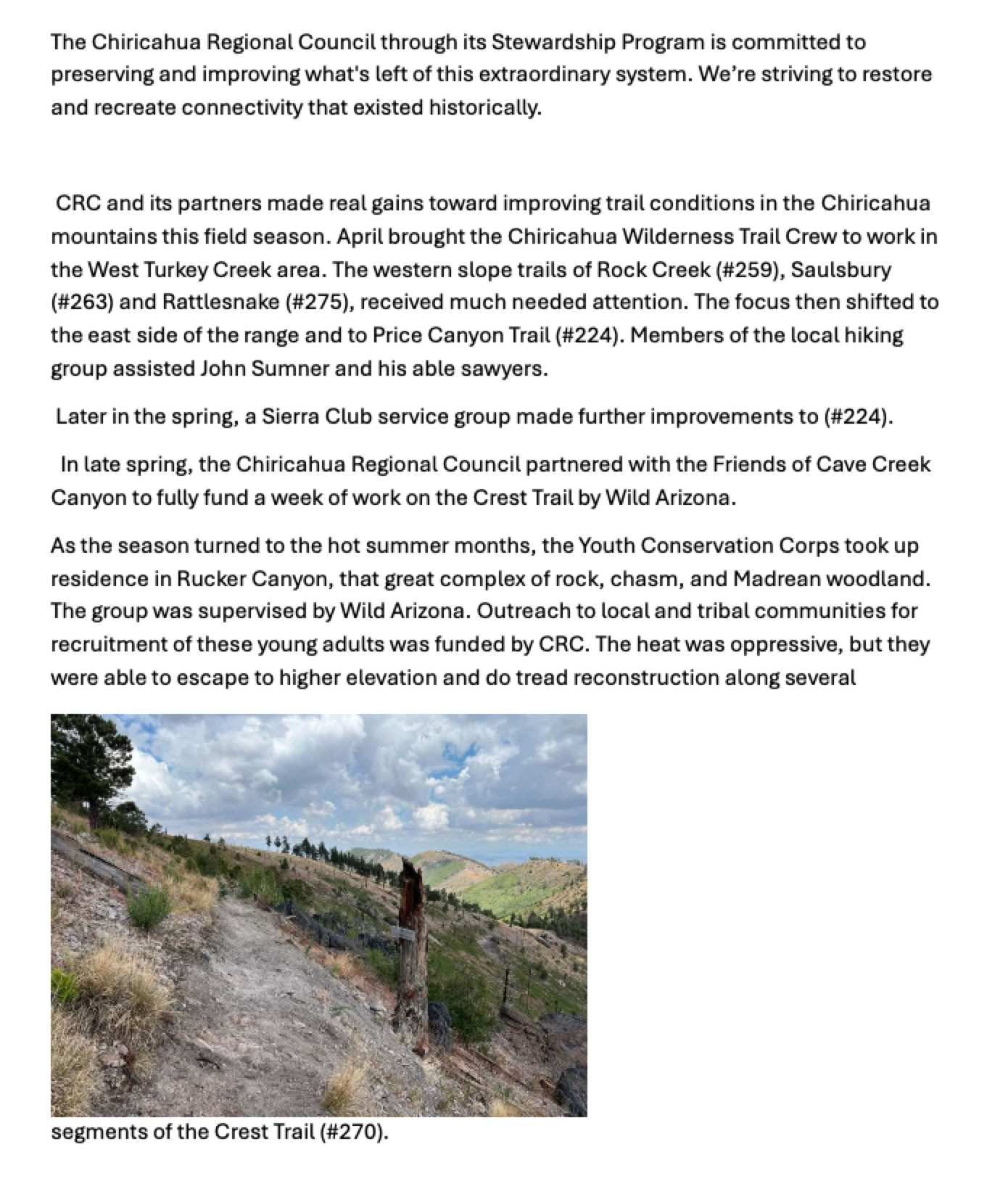
Working with our partners at Wild Arizona, and in collaboration with FoCCC (read their latest newsletter here) CRC has received grant funding to rework portions of the Snowshed Trail (#246) on the Coronado National Forest. This project carries special significance: we have invited young adult members of the Fort Sill (Oklahoma) Apache Tribe to participate while exploring their ancestral territory. As many of you know, a Chiricahua Apache band— those led by Geronimo — was forcibly removed from these lands by the U.S. Army in 1886. After much hardship, survivors from the band eventually made their way to Oklahoma. To this day there is no federally recognized Chiricahua Apache tribe or reservation in their homeland. The Fort Sill Apache Tribe holds federal recognition and its members trace their heritage directly to the Chiricahua and Warm Springs Apaches. The Snowshed Project is an opportunity for this group of young adults to reconnect with ancestral lands, and we are deeply honored to be part of it. Assisting in this visit, the Southwestern Research Station has graciously offered to provide space on their grounds. This collaborative effort is building on last year’s “Field Camp” event hosted by Wild Arizona. Read more about WA’s work in the Chiricahuas here We look forward to welcoming them to the canyon this spring.

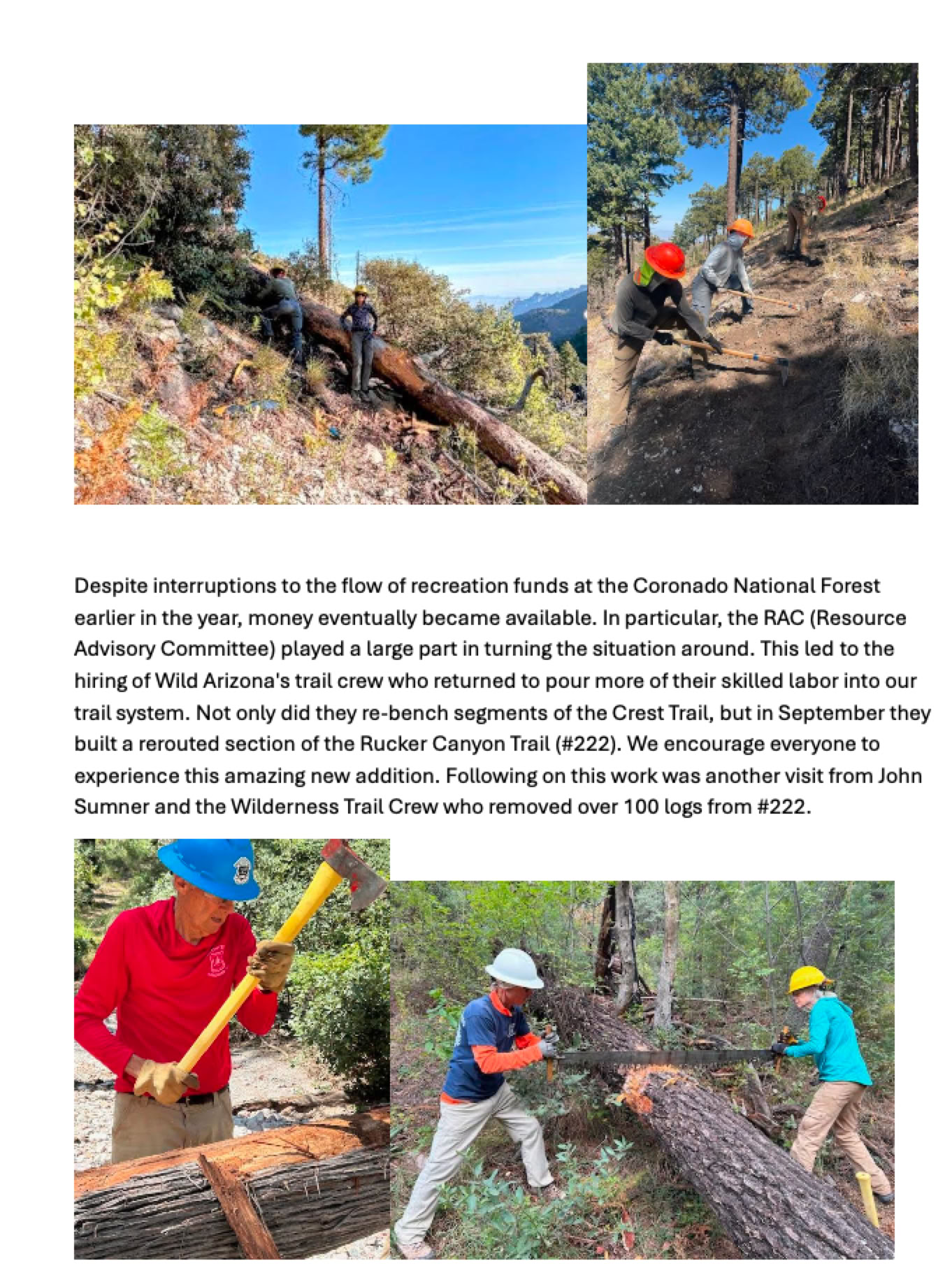
Separately, John Sumner and the Chiricahua Wilderness Trail Crew are returning for a week-long volunteer event focused on trails connected to West Turkey Creek — specifically Rock Creek and Rattlesnake Trails. And following closely on their heels, the Sierra Club will be hosting a service trip led by Howard Kellogg, who has worked in these mountains for several seasons. Their crew will focus on the Crest Trail south of Chiricahua Peak and the Mormon Ridge Trail near Chiricahua Saddle, and base out of historic Cima Cabin. Read about the Club’s service trip here We are grateful to all of these dedicated volunteers.

Invasive Species Work Continues

CRC and our partners recently hosted a workshop on the treatment of exotic invasive species in Cave Creek Canyon, and a follow-up workshop is planned for this spring. Our work on this front extends beyond the National Forest — we’re also advising and supporting invasive species treatment on private lands in the area. Together with Wild Arizona, we’re applying for a second grant from the State of Arizona to fund further treatment work in the canyon. We’ll share more details as that effort advances.


The Border Wall and What It Costs Us

Those of us who live in and love this landscape have watched with grief as border wall construction continues to cut through some of the most ecologically sensitive terrain in North America. The wall is not merely a political structure — it is a wound on the land. Its construction draws down precious aquifers to produce cement, fragments wildlife corridors that took millennia to form, and diminishes something harder to quantify but no less real: the singular beauty and integrity of this place we call home. Sky Island Alliance continues its important wildlife studies along the border, work that CRC helped support last year with a $5,000 contribution. Watch a recent reel from the border here That research matters more than ever.

Data Centers: Community Voices Make a Difference

This has been a consequential few weeks in Cochise County’s reckoning with the data center industry. On March 11, the Board of Supervisors voted unanimously to adopt Comprehensive Plan 2045, the county’s new long-range policy framework for land use and development — with water use and the potential arrival of large data centers dominating public comment. That same week, the Planning and Zoning Commission took two significant actions: first voting unanimously to adopt a zoning amendment establishing baseline development standards for the industry, then narrowly voting 5–4 to recommend that the Board of Supervisors impose a 120-day moratorium on new data center applications while the county continues refining its regulations.

CRC submitted formal written comments to the Commission urging adoption of rigorous, enforceable standards — including mandatory groundwater impact assessments, aquifer recharge requirements, prohibition on potable water use for cooling, full public transparency, and annual independent auditing of actual water and energy consumption. You can read our full comment here.

The matter now moves to the Board of Supervisors, and we will continue to monitor and engage as it does.

Looking Ahead

Our Board of Directors and Advisory Council will hold its next internal meeting on April 11. We’ll share a member update with news and next steps in the weeks that follow. As always we deeply appreciate your continued support for CRC and in turn our work to protect this remarkable landscape and the community that cares for it.

Warm regards,

Dirk Sigler

President

Chiricahua Regional Council

Stewardship Program

Education: 

Backcountry Preparedness Workshop 

Following our Heritage Days participation, CRC and FoCCC hosted a backcountry preparedness workshop on September 21st, led by Education Coordinator Margaret Wilch and CRC’s Dirk Sigler this educational initiative attracted 15 participants and provided essential safety training for outdoor enthusiasts. Follow-up workshops are planned for later this fall, demonstrating our commitment to ongoing community education. 

Exotic Invasive Species Management 

The CRC continued its critical work addressing invasive species threats to our ecosystem. Through our partnership with Wild Arizona these ongoing efforts have successfully treated non-native invasive plants, including Tree of Heaven and other problematic species along Cave Creek. This work is essential for maintaining the ecological integrity of our mountain ecosystems. Planned for November is a workshop open to the public in Paradise, AZ to train in methods of eradicating exotic plant species. Wild Arizona's Jonathan Patt will be the trainer. This is a co-sponsored event with Friends of Cave Creek Canyon 

Partnerships and Collaborations 

Throughout this period CRC strengthened key partnerships with:
• Friends of Cave Creek Canyon- Joint trail projects and educational initiatives 

• Wild Arizona- Multiple project collaboration on the trail system and non-native invasive species removal 

• Coronado National Forest- Youth Conservation Corps program- Mentorship and recruitment support 

• National Forest Foundation- Partner grant funding for trail development • Local tribal communities- Cultural outreach and collaborative planning Looking Forward 

The CRC’s accomplishments during this period demonstrate our multi-faceted approach to conservation through trail stewardship, community education, invasive species management, and collaborative partnerships. Our work continues to build bridges between conservation science, community engagement, and cultural heritage preservation in the Chiricahua Mountains.

____________________________________________________________________

Clear Signs Along The Crest

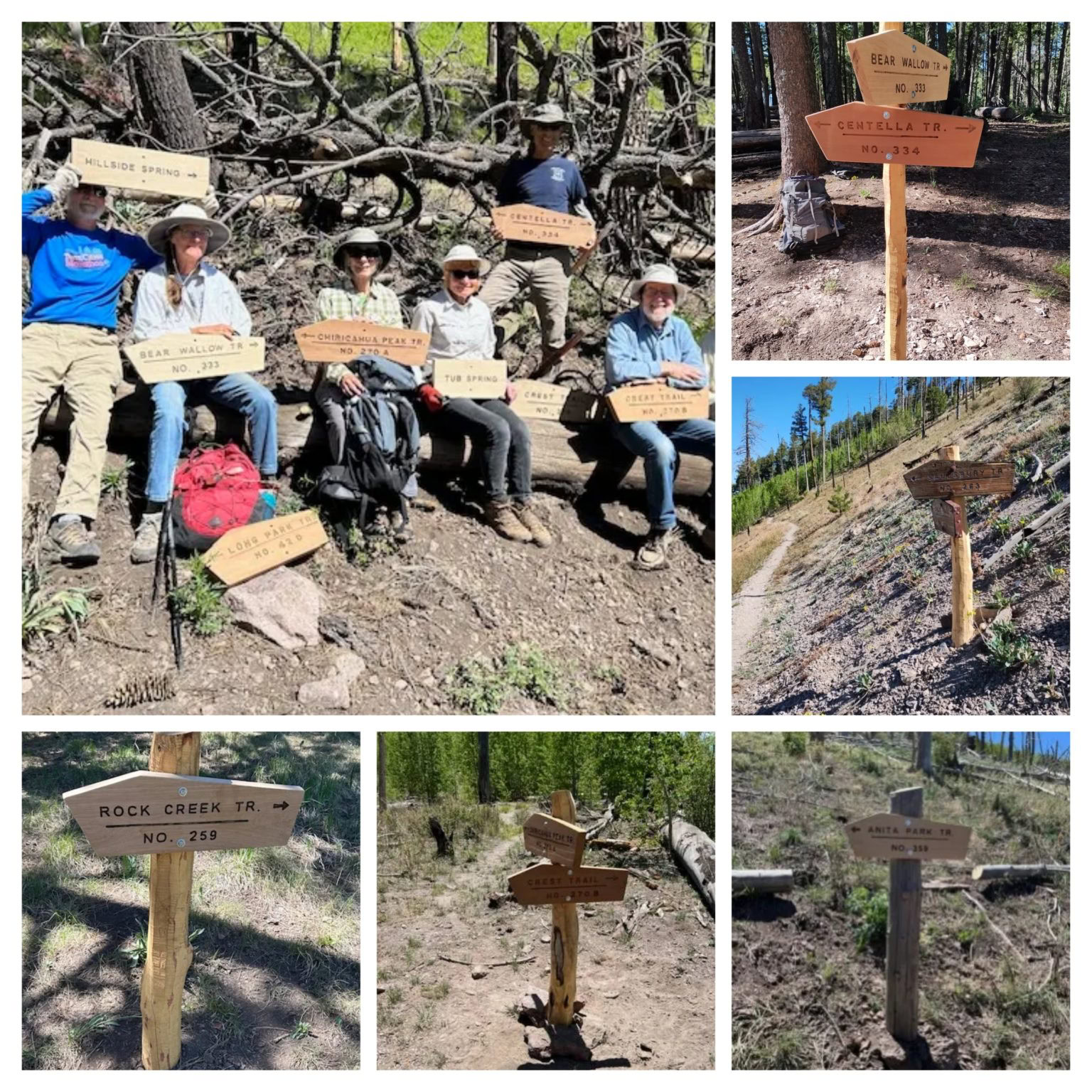
CRC’s Stewardship Program replaced many of the posts and signs along the Chiricahua Crest Trail this spring. The project grew out of discussions between CRC President Dirk Sigler and Douglas District Ranger Doug Ruppel to develop a plan to renovate the deteriorated signage across the trail system. This long-standing need goes back over a decade. As a practical matter recreation projects of this kind are now carried out in the Chiricahuas through coordination of the Forest Service and participating nonprofits like CRC.

Coronado fire crews cut and dressed juniper logs from fuel reduction projects in the Rucker Canyon area. The Forest Service delivered the wood using mules. Volunteers then stepped in to plant the posts and Dirk made new signs with tools and materials provided by the Douglas Ranger District.

__________________________________________________________________

Forest Service Update

March 5, 2025


Chiricahua Regional Council Statement

The Chiricahua Regional Council expresses profound concern over recent federal staffing reductions threatening our vital trail maintenance partnerships. Nationwide 3,400 workers have been abruptly fired. This represents 10% of US Forest Service personnel and the disturbing part is that the firings are disproportionately affecting Recreation staff. A troubling feature of the current Washington administration’s assault on the Forest Service is an instruction to staff that they may not even communicate with their partners. In other words a gag order.

A similar reduction of National Parks Service personnel (see attached article) has already led to access problems for the public. But that pales in comparison to what’s happening at the US Forest Service. It is our position that the manner in which this has been implemented is illicit and we are advocating for a reversal of these cuts.

The force reductions at the USFS are having a direct impact already. The Douglas District which administers the Coronado National Forests within the Chiricahua and Peloncillo mountains is down to a skeleton crew. Several planned projects representing years of collaborative work between our organization, the communities in the region, other nonprofits, and federal agencies have been postponed. These partnerships have been the most effective tool for maintaining access to the public land in our region. In fact all of Southeast Arizona is being affected. Our trail system will continue to degrade if this situation doesn’t improve.

We urge members to contact their representatives expressing support for the dedicated public servants who administer our public lands. These professionals are stewards of America’s natural heritage and deserve our advocacy during this challenging time. We urge immediate reconsideration of these cuts to preserve both our natural heritage and the community relationships that sustain it. Protect our public lands!

**Contact Information:**

          Senator Ruben Gallego
          Russell Senate Office Building
          2 Constitution Avenue NE
         Washington, DC 20510
          Phone: (202) 224-4521

____________________________________________________________________

SUNDAY, DECEMBER 5, 2010

Coronado Forest Plan Under Major Criticism

by Noel Snyder


Every national forest operates under a forest plan that presents goals and actions to achieve goals.  These plans are periodically revised.  In March, the U.S. Forest Service released for public comment a Draft Forest Plan for future management of the Coronado National Forest.  This is a plan to replace the existing plan of 1986 and is expected to guide policies for the next 20 years.  Unfortunately, the new plan is limited largely to broad “feel-good” goals.  And because specific actions and their associated costs are mostly not presented, it isn’t possible to evaluate whether the goals are achievable, whether appropriate means will be employed to achieve goals, and how the Forest Service will resolve conflicts among goals.  In view of the major budgetary cuts the Forest Service has already experienced and can anticipate, it seems highly unlikely that adequate resources will exist to achieve many of the goals mentioned.  If adequate resources are not available which goals will be sacrificed?  In essence, the Forest Service seems to be asking the public to endorse its future actions without letting the public know what those actions may be.  

For those familiar with the detail of the 1986 Coronado plan, the newly released plan is astonishingly vague and leaves many matters only minimally addressed or simply unaddressed.  For example, missing from the plan is any discussion of border problems or how the the Forest Service is planning to address problems anticipated from climate change.  Areas of the Coronado close to the border have been under siege from illegal immigrants, who have trampled “highways” across the terrain, left mountains of trash, and repeatedly started major fires that have cost the taxpayer many millions of dollars.  Many of the trails on the Coronado are now effectively “owned” by well-armed drug smugglers, at least at night.  Yet the new plan says nothing about these problems and how they will be corrected.   If left uncorrected, these problems will undermine many other aspects of the plan.

Nevertheless, the aspect of the new plan that is by far the most troubling is the absence of any clear recognition of the overriding importance of what many observers maintain is the defining attribute of the Coronado – its tremendously high level of biodiversity.  This biodiversity is unmatched by any other national forest and has been honored nationally and internationally.  Protecting biodiversity is an overall national priority, and it is the Coronado’s outstanding biodiversity that supports a thriving ecotourism economy for many local communities.  Biodiversity is in fact the economic life blood of the region. This value should be featured in the plan as a central focus around which other goals need to be harmonized.  It is not.

Concerns over the Coronado’s biodiversity came into national focus in the 1990s when the Coronado Forest released a proposal to convert several of the Sky Island Units it administers into a National Recreation Area (NRA).  This was a proposal resulting not from public demand but from its potential to increase the Coronado’s budget. However, an NRA can only come to pass with public support and Congressional action.  In public meetings the proposal was blown away by vigorous and nearly unanimous opposition from people across the social and economic spectrum, who viewed conversion of the forest into a playground for mass recreation as a very bad idea.  What emerged instead was overwhelming public endorsement of low-impact quiet recreation on the forest consistent with maintaining the biological riches of the forest.  The NRA proposal was quietly dropped, but one wonders if anyone on the current planning staff of the Coronado remembers this embarrassing affair.  In the current draft plan, recreation development is mentioned 226 times while biodiversity is mentioned only 6 times.

To be fair, the Forest Service has belatedly announced it will be including a new Cave Creek Zoological and Botanical Area (ZBA) in its revisions to the draft plan, an area protecting a canyon with by far the highest density and diversity of nesting raptors known anywhere in the U.S.  But as welcome as the new ZBA is, the increased motorized recreation emphasis across the forest that is allowed in the new plan works directly against maintaining biodiversity values.  Under the existing forest plan, the Coronado already has far more roads than are permissible.  Biodiversity is not yet receiving the overall recognition and priority it deserves in the new plan.

In February the Forest Service expects to release a revised forest plan and a Draft Environmental Impact Statement on the plan.  It will be crucial for the public to respond with comments on these documents.